
Crystal-clear pool water doesn't happen by accident. It comes from maintaining the right balance between several water chemistry parameters and consistently monitoring how those parameters change.
If you're new to pool maintenance, terms like pH, free chlorine, total alkalinity, calcium hardness, CYA, ORP, TDS, and salinity can sound complicated.
The good news is that you don't need to be a chemist to understand pool chemistry.
This guide breaks down the most important pool water parameters, explains what each one means, provides commonly used target ranges, and shows how they work together to help keep your pool clean, clear, comfortable, and properly maintained.
Pool Water Chemistry Chart
Use the chart below as a quick reference when checking your pool water.
Keep in mind that recommended ranges can vary depending on your pool type, sanitizer system, surface material, climate, and equipment manufacturer. Always follow the instructions provided with your pool chemicals and equipment.

*These are commonly used reference ranges, not universal requirements. Always follow the recommendations for your specific pool, sanitizer system, and equipment.
Why Does Pool Water Chemistry Matter?
Maintaining balanced pool water isn't just about making the water look beautiful.
Proper water chemistry helps with three important areas:
1. Swimmer Comfort
Water that is too acidic or too alkaline can contribute to eye and skin irritation.
Maintaining an appropriate pH and overall water balance helps create a more comfortable swimming environment.
2. Effective Sanitization
Sanitizers such as chlorine play a critical role in controlling microorganisms and organic contaminants.
However, sanitizer performance depends on more than simply adding chlorine.
Factors such as pH, CYA, temperature, sunlight, water circulation, and contaminant load can all influence how your pool water behaves.
3. Pool and Equipment Protection
Poorly balanced water can contribute to:
· Corrosion
· Scaling
· Surface damage
· Equipment problems
· Cloudy water
That's why pool chemistry should be viewed as a system rather than a collection of unrelated numbers.
The Core Pool Chemistry Parameters
For most pool owners, five parameters form the foundation of basic pool water chemistry:
pH
Free Chlorine
Total Alkalinity
Calcium Hardness
Cyanuric Acid
Let's look at each one.
1. pH: The Foundation of Pool Water Balance
pH measures how acidic or basic your pool water is on a scale from 0 to 14.
For many swimming pools, the commonly recommended range is: 7.2–7.8
Many pool owners aim for approximately 7.4–7.6 because this range generally provides good swimmer comfort while supporting effective chlorine performance.
What happens when pool pH is too low?
When pH falls below the recommended range, the water becomes more acidic.
Potential problems include:
- Eye and skin irritation
- Corrosion of metal components
- Damage to certain pool surfaces
- Increased risk of equipment corrosion
What happens when pool pH is too high?
High pH can contribute to:
- Cloudy water
- Scale formation
- Reduced chlorine effectiveness
- Difficulty maintaining clear water
If your pH repeatedly rises or falls, don't simply keep adding pH adjustment chemicals.
Look at the bigger picture, including total alkalinity, aeration, water source, chemical additions, and pool usage.
2. Free Chlorine: Your Pool's Primary Sanitizer
Free chlorine is one of the most important parameters to monitor in a chlorine-sanitized pool.
It helps control microorganisms and organic contaminants in the water.
For many residential pools, a commonly used reference range is: 1–3 ppm Free Chlorine
However, the appropriate chlorine level can depend on:
· CYA concentration
· Pool type
· Sanitizer system
· Sunlight exposure
· Water temperature
· Pool usage
· Local recommendations
So there isn't one chlorine number that is perfect for every pool.
Why is free chlorine important?
If the available sanitizer level becomes too low, microorganisms and algae can multiply more easily.
But higher chlorine isn't automatically better.
Extremely high chlorine levels can cause swimmer discomfort and may affect some pool materials over time.
What causes a strong chlorine smell?
A strong chlorine-like smell does not necessarily mean that your pool simply has "too much chlorine."
Pool odor can be associated with combined chlorine compounds, including chloramines, which can form when chlorine reacts with contaminants.
This is one reason why maintaining proper sanitation and regularly monitoring pool water is important.
3. Total Alkalinity: Your Pool's pH Buffer
Total Alkalinity (TA) measures the water's ability to resist changes in pH.
For many pools, a commonly used target range is:80–120 ppm
Think of alkalinity as a buffer that helps prevent large or rapid pH changes.
What happens when alkalinity is too low?
Low alkalinity can make your pH unstable.
You may notice that pH changes quickly even after you adjust it.
What happens when alkalinity is too high?
High alkalinity can make pH more difficult to adjust and may contribute to persistent high-pH conditions and scale formation.
Should you adjust alkalinity before pH?
When alkalinity is significantly outside the desired range, addressing it first is often a useful approach.
However, pool chemistry isn't always a simple "one number at a time" process.
The best approach is to look at pH and alkalinity together and make adjustments according to your pool's specific conditions.
4. Calcium Hardness
Calcium Hardness measures the concentration of dissolved calcium in your pool water.
For many residential pools, a commonly used reference range is:200–400 ppm
The appropriate level can vary depending on the pool surface, water chemistry, and manufacturer recommendations.
What happens when calcium hardness is too low?
Water with insufficient calcium can become more corrosive and may contribute to deterioration of certain pool surfaces and equipment.
What happens when calcium hardness is too high?
Excess calcium can contribute to:
· Scale formation
· Cloudy water
· Deposits on pool surfaces
· Deposits on equipment
Unlike pH or chlorine, calcium hardness can be difficult to reduce without partially replacing pool water.
5. Cyanuric Acid (CYA): Protecting Chlorine From Sunlight
Cyanuric Acid (CYA) is commonly used as a chlorine stabilizer in outdoor pools.
It helps protect chlorine from being rapidly degraded by ultraviolet (UV) sunlight.
For many outdoor chlorine pools, a commonly used reference range is: 30–50 ppm
The appropriate CYA level depends on the pool's sanitation system and local recommendations.
Why does CYA matter?
Without adequate stabilization, sunlight can break down chlorine relatively quickly.
However, more CYA isn't always better.
Excessively high CYA changes the relationship between chlorine and its sanitizing effectiveness.
That's why free chlorine and CYA should be considered together.
Additional Pool Water Parameters
Once you understand the core parameters, several additional measurements can provide a more complete picture of your pool water.
These measurements are especially relevant for saltwater pools, automated systems, smart monitoring, and long-term water quality tracking.
6. ORP: Oxidation-Reduction Potential
ORP (Oxidation-Reduction Potential) measures the oxidation-reduction potential of water and is expressed in millivolts (mV).
In pool water, ORP can provide an additional indication of the water's oxidation environment and is commonly used in automated pool monitoring and chemical dosing systems.
However: ORP is not the same as free chlorine.
An ORP reading should not be treated as a direct measurement of chlorine concentration.
ORP can be influenced by factors including:
· pH
· Free chlorine
· CYA
· Temperature
· Water chemistry
· Sensor condition
This makes ORP particularly useful when it is interpreted alongside other pool water measurements.
7. Water Temperature
Temperature isn't technically a chemical parameter, but it is an important part of pool water monitoring.
Water temperature affects:
· Swimmer comfort
· Chlorine demand
· Algae growth
· Chemical reaction rates
· Pool equipment operation
Warmer water and hot weather can increase chlorine demand and create conditions that encourage biological growth.
Monitoring temperature alongside pH and sanitizer levels can therefore help pool owners understand why water chemistry changes over time.
8. Salinity: Important for Saltwater Pools
Salinity refers to the concentration of dissolved salts in water.
It is especially important for pools equipped with a saltwater chlorine generator.
A salt chlorine generator uses dissolved salt to produce chlorine through electrolysis.
The appropriate salt concentration depends on the specific chlorine generator.
Always follow the equipment manufacturer's recommended operating range.
What happens when salinity is too low?
Depending on the system, low salt levels may result in:
· Reduced chlorine production
· A low-salt warning
· Poor sanitizer performance
What happens when salinity is too high?
Excessive salt concentration can move the system outside its recommended operating range and may contribute to a saltier swimming environment.
For saltwater pools, monitoring salinity is therefore an important part of routine maintenance.
9. EC: Electrical Conductivity
EC (Electrical Conductivity) measures how easily electrical current can pass through water.
Dissolved ions such as salts and minerals increase water's electrical conductivity.
As a result, EC can provide useful information about changes in the water's overall ionic content.
EC can be particularly useful for:
· Monitoring changes over time
· Identifying changes in dissolved ionic content
· Supporting saltwater pool monitoring
· Comparing water conditions before and after water replacement
Is EC the same as TDS?
No. EC measures electrical conductivity, while TDS estimates the amount of total dissolved solids.
The two measurements are related because many dissolved substances affect conductivity, but they are not interchangeable.
10. TDS: Total Dissolved Solids
TDS (Total Dissolved Solids) represents the total amount of dissolved material in water.
These substances can include:
· Salts
· Minerals
· Dissolved chemicals
· Other dissolved compounds
TDS can increase over time due to:
· Chemical additions
· Evaporation and refill cycles
· Swimmers
· Environmental contaminants
· Salt in saltwater pools
Does high TDS automatically mean a pool is unsafe?
No. TDS is a broad measurement. It does not tell you exactly which substances are dissolved in the water.
A TDS reading should therefore be considered alongside:
· pH
· Free chlorine
· Total alkalinity
· Calcium hardness
· CYA
· Water clarity
· Circulation
· Other relevant pool conditions
TDS is most useful as part of a broader water quality monitoring strategy, rather than as a standalone measurement of pool safety.
How These Pool Water Parameters Work Together
This is one of the most important things to understand about pool chemistry:
The numbers don't exist independently.
They interact with each other.
For example:
pH → Chlorine Performance
pH affects how effectively chlorine works in the water.
CYA → Chlorine and Sunlight
CYA helps protect chlorine from UV degradation, but excessive CYA changes the chlorine relationship and needs to be considered when evaluating sanitizer levels.
Temperature → Chlorine Demand
Higher temperatures can increase chlorine demand and encourage biological activity.
Salinity → Saltwater Chlorine Generation
Salt concentration affects the operation of a saltwater chlorine generator.
ORP → Oxidation Conditions
ORP provides another way to observe the oxidation-reduction environment of the pool water.
EC → Dissolved Ions
EC changes as the concentration of conductive dissolved ions changes.
TDS → Overall Dissolved Material
TDS provides a broader indication of dissolved substances accumulating in the water.
This is why looking at just one number rarely tells the whole story.
How Often Should You Test Pool Water?
There isn't one testing schedule that works for every pool.
Testing frequency depends on:
· Pool usage
· Weather
· Water temperature
· Pool size
· Sanitizer system
· Pool chemistry stability
· Recent chemical adjustments
As a general starting point, many residential pool owners check:
pH and Free Chlorine
Several times per week
Especially during:
· Hot weather
· Heavy pool use
· After heavy rain
· Algae problems
· Cloudy water
Total Alkalinity
Weekly or as needed
Once your pool is stable, testing frequency can be adjusted according to your pool's conditions.
Calcium Hardness and CYA
These generally don't need to be checked as frequently as pH and chlorine, but should be monitored periodically and whenever water conditions or treatment requirements change.
Salinity
Saltwater pool owners should monitor salinity according to the requirements of their salt chlorine generator.
ORP, Temperature, EC, and TDS
These can be useful for continuous or trend-based monitoring, particularly when using a multi-parameter pool monitor.
A Simple Pool Maintenance Routine
Maintaining a pool doesn't have to become a daily chemistry experiment.
Consistency is more important than constantly chasing individual numbers.
Step 1: Test the Water
Check the parameters that are relevant to your pool:
· pH
· Free Chlorine
· Total Alkalinity
· Calcium Hardness
· CYA
· Salinity, if applicable
Additional measurements such as ORP, temperature, EC, and TDS can provide useful information for more advanced monitoring.
Step 2: Confirm Unexpected Readings
If a measurement suddenly looks unusual, confirm the result before making major chemical adjustments.
This is particularly important when using test strips or other testing methods that can be affected by sampling technique and environmental conditions.
Step 3: Adjust Chemicals Carefully
Always follow the product label and manufacturer instructions for dosage, mixing, application, and safe swimming conditions.
Avoid making large adjustments simply because one reading looks slightly outside your target.
Step 4: Clean the Pool
Regularly:
· Skim leaves and debris
· Brush the pool walls
· Vacuum the pool
· Clean the filter as required
· Empty skimmer and pump baskets
Good physical maintenance reduces the workload on your filtration and sanitation systems.
Step 5: Maintain Proper Circulation
Good circulation helps distribute chemicals and move water through the filtration system.
Your ideal pump schedule depends on your pool size, equipment, climate, and filtration system.
Follow your equipment manufacturer's recommendations.
Can a Smart Pool Monitor Make Water Testing Easier?
Traditional test strips and liquid test kits can be useful for periodic testing.
However, manual testing requires you to remember to take measurements and record the results.
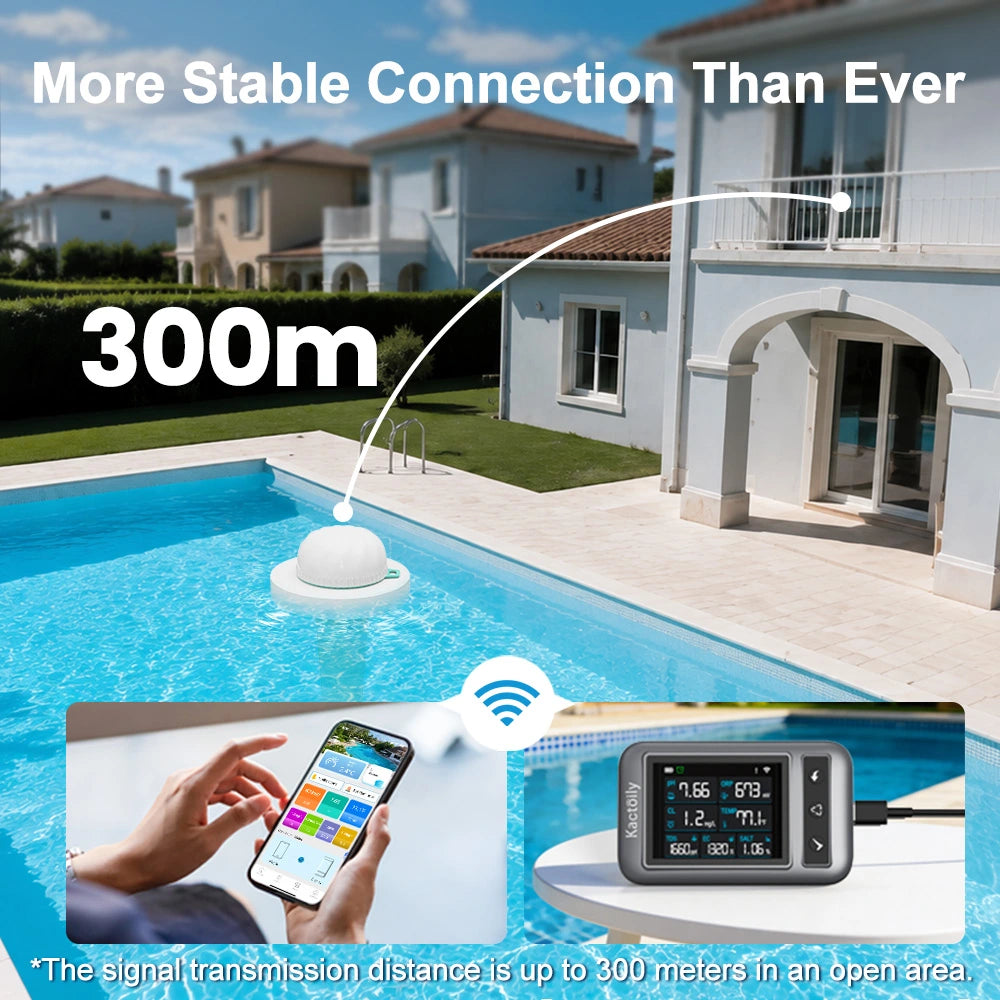
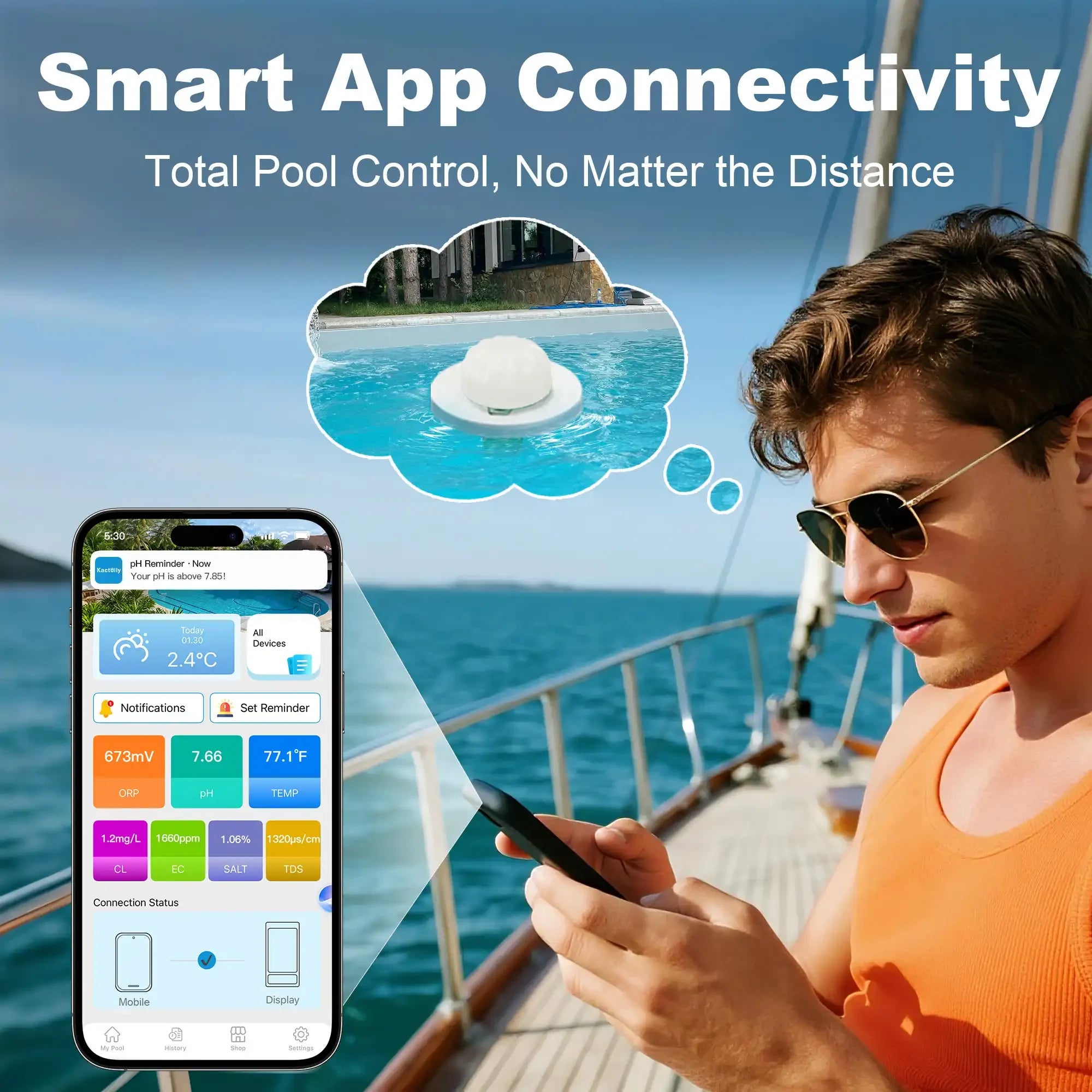
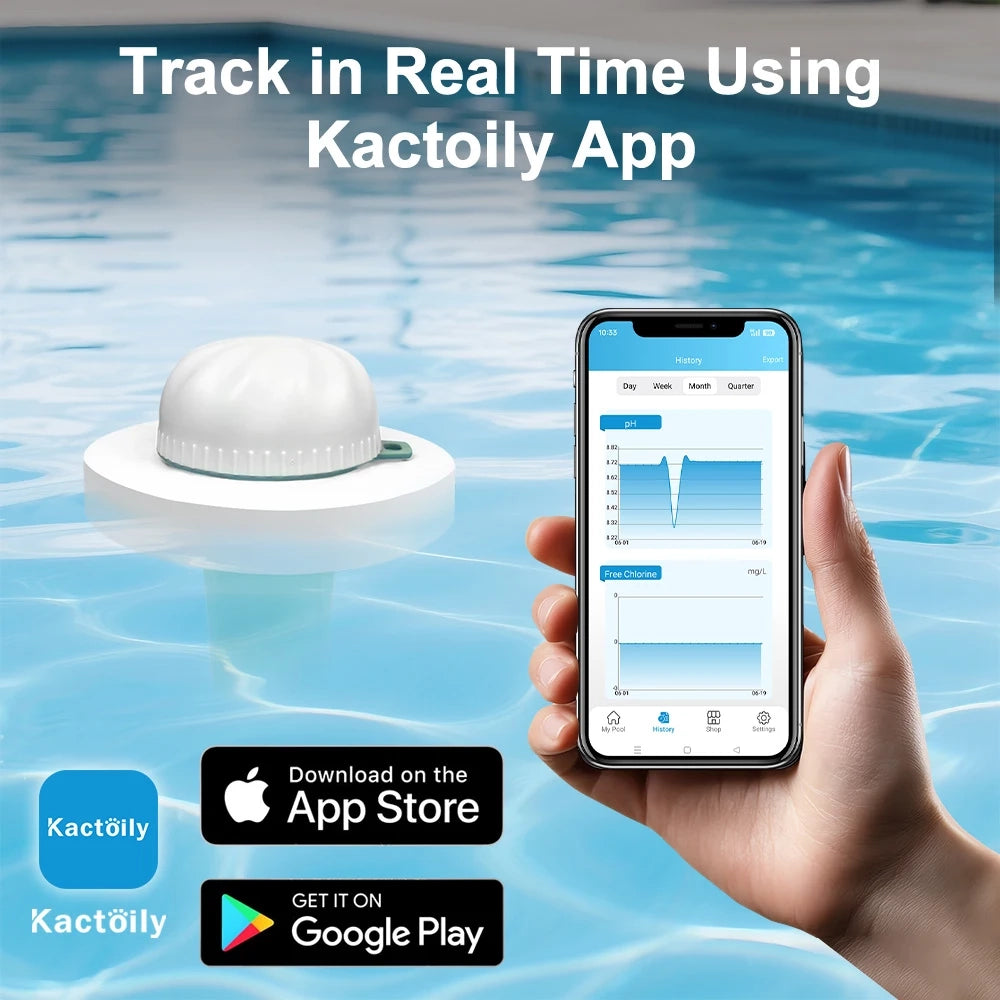
A connected multi-parameter pool monitor provides another approach: continuous monitoring and trend tracking.
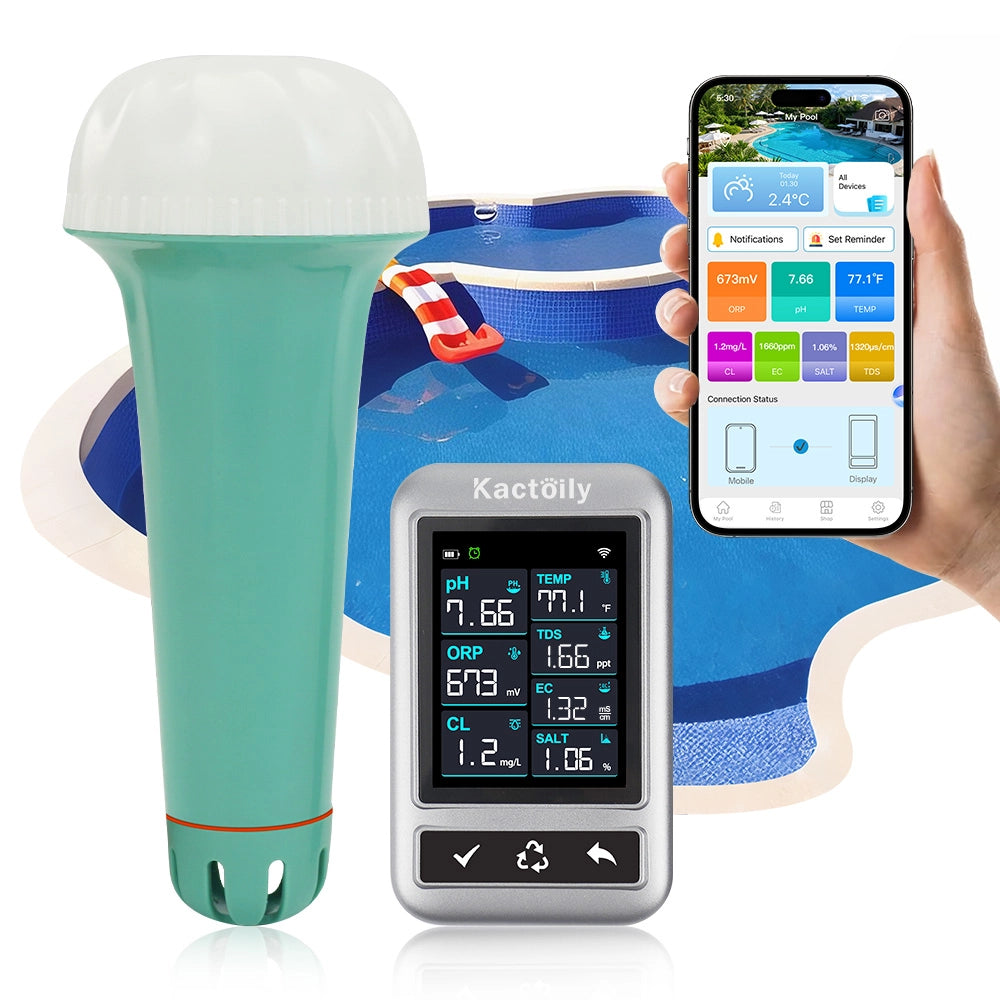
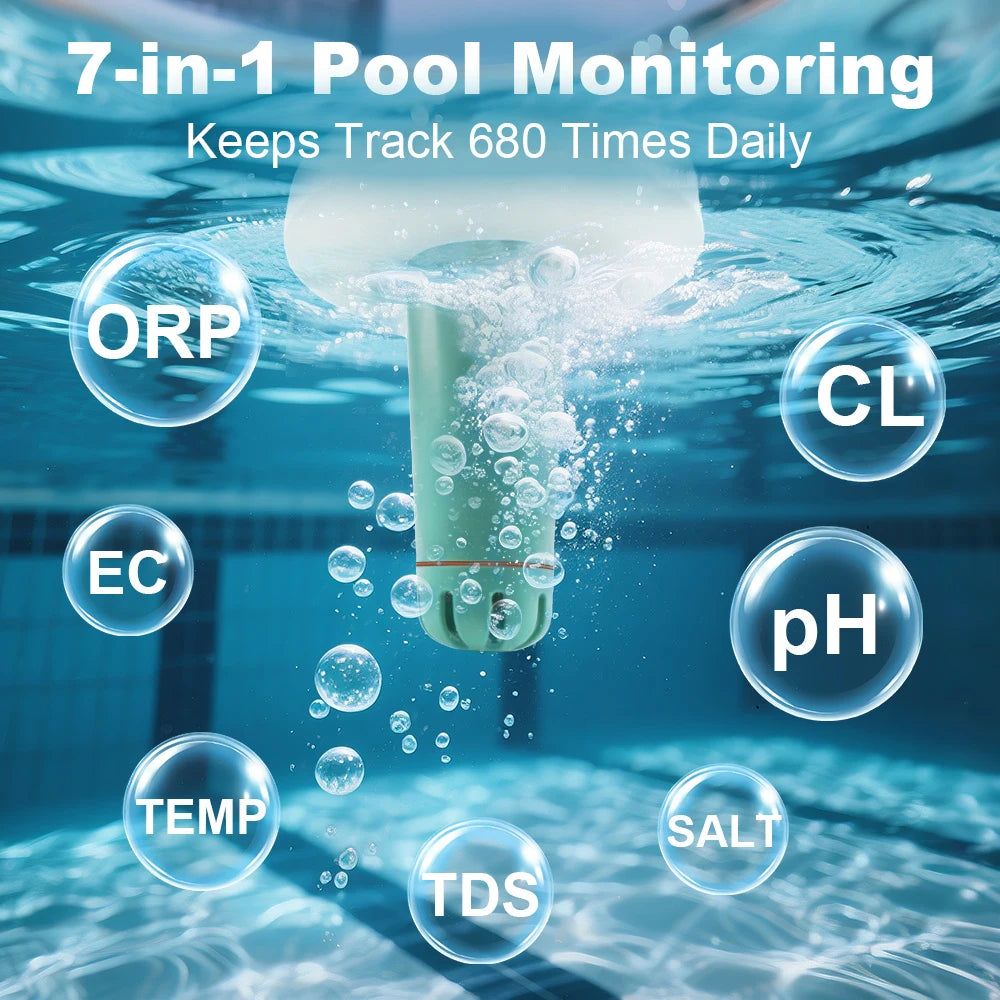
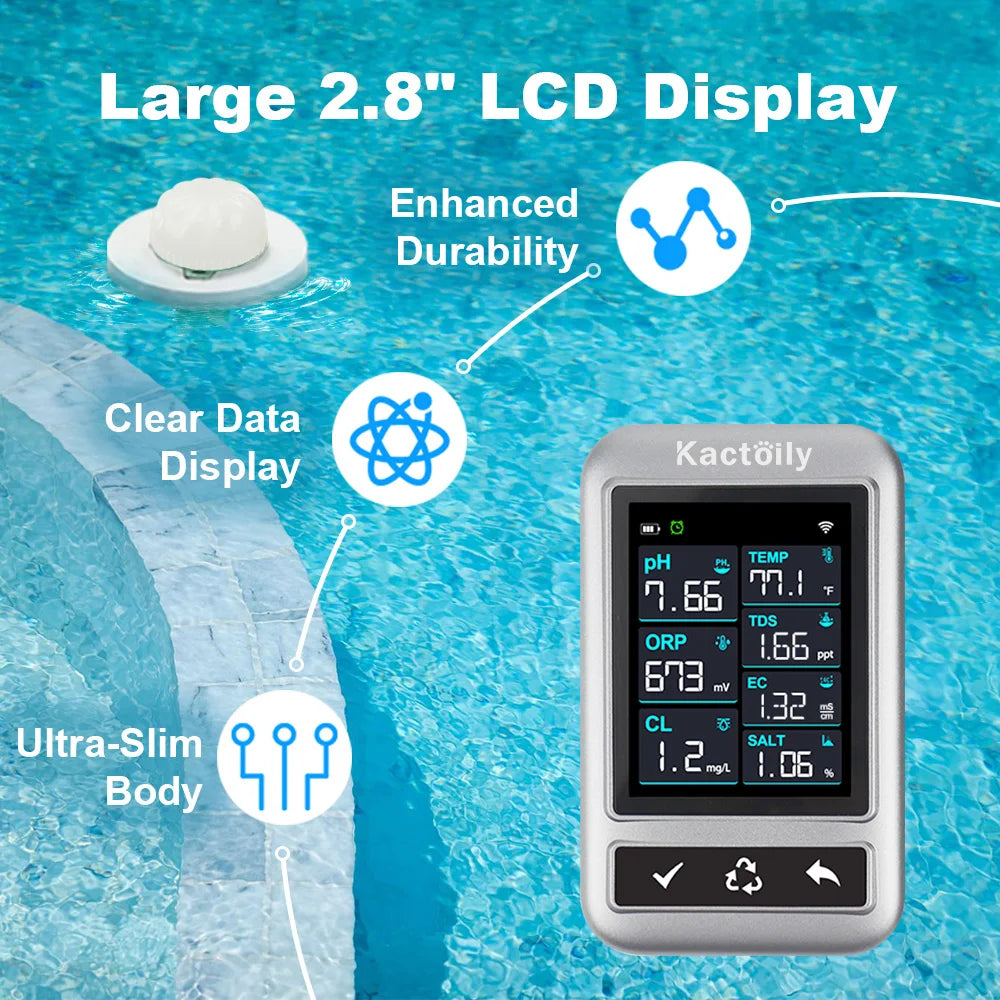
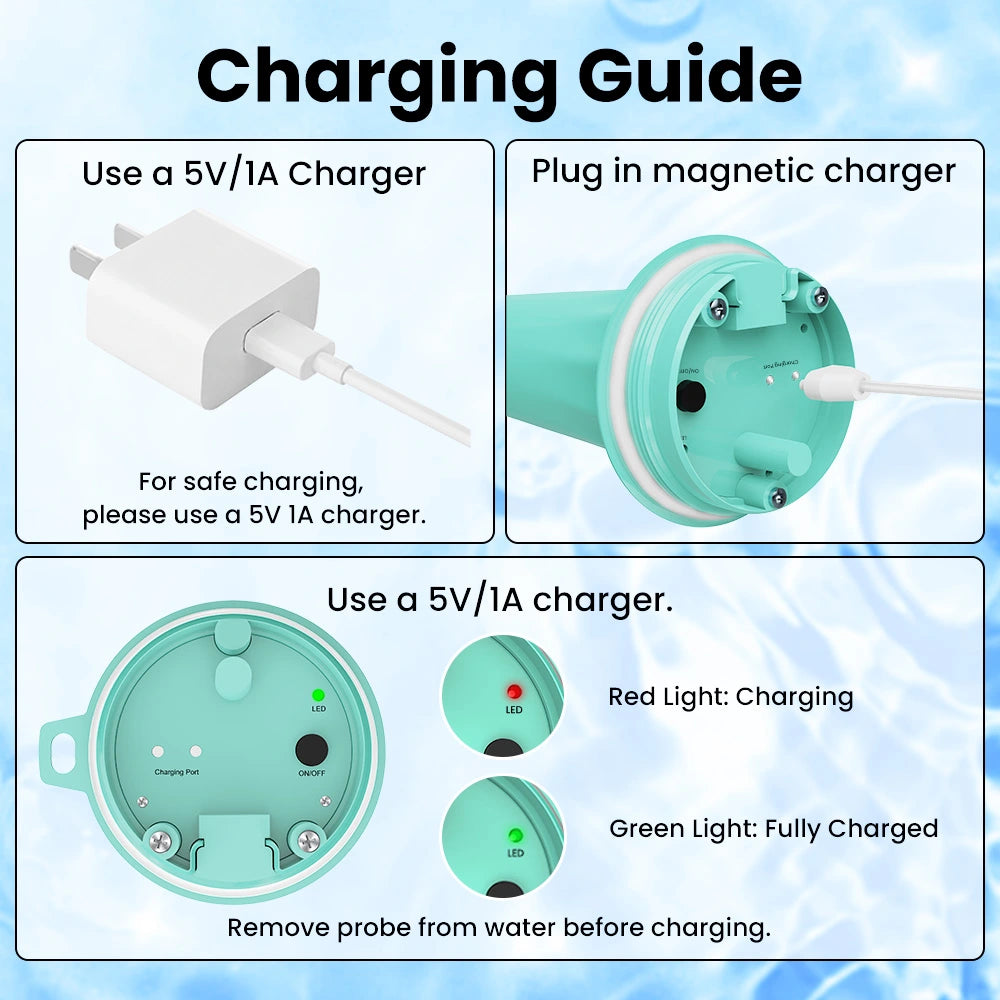
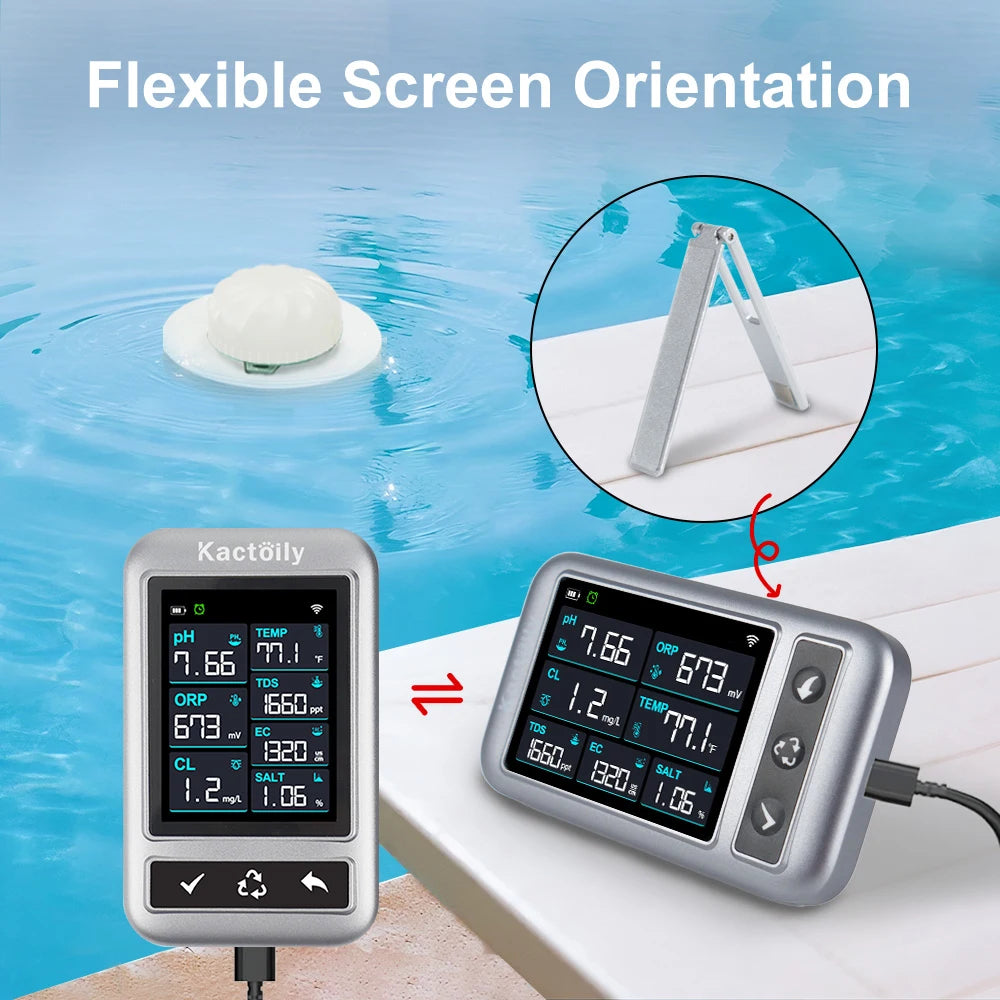
For example, the Kactoily 7-in-1 WiFi Pool Monitor can monitor:
· pH
· Free Chlorine
· ORP
· Temperature
· EC
· Salinity
· TDS
Instead of seeing only an occasional snapshot of your pool water, continuous monitoring can help you understand how these parameters change over time.
For example, you may notice:
pH gradually increasing → investigate alkalinity and other causes
Free chlorine dropping faster than usual → investigate sunlight, CYA, temperature, pool use, and contaminant load
Salinity changing → check water replacement, dilution, or saltwater system conditions
TDS gradually increasing → monitor long-term dissolved material accumulation
The purpose of a smart monitor isn't to replace good pool maintenance.
It is to make consistent monitoring easier and help you identify trends earlier.
Why Monitor Multiple Pool Water Parameters?
A single water measurement only tells you part of the story.
For example, a chlorine reading may tell you how much free chlorine is present, but it doesn't tell you:
· Why chlorine is being consumed quickly
· Whether pH is affecting sanitizer performance
· How temperature is changing chlorine demand
· Whether a saltwater system has the appropriate salt concentration
· How dissolved substances are changing over time
This is where multi-parameter monitoring becomes useful.
By monitoring several measurements together, pool owners can build a more complete picture of their water conditions.
FAQ
What is the ideal pH for a swimming pool?
For many swimming pools, the commonly recommended pH range is 7.2–7.8.
Many pool owners target approximately 7.4–7.6, but the appropriate target depends on the pool and sanitizer system.
What should free chlorine be in a pool?
For many residential pools, a commonly used reference range is 1–3 ppm.
However, the appropriate chlorine level depends on factors including CYA, pool type, sanitizer system, sunlight, temperature, and local recommendations.
What should total alkalinity be in a pool?
A commonly used reference range is 80–120 ppm.
The ideal range can vary depending on the pool and its water chemistry.
What is calcium hardness in a pool?
Calcium hardness measures the amount of dissolved calcium in the water.
A commonly used range for many pools is approximately 200–400 ppm, although the appropriate target depends on the pool surface and other water chemistry factors.
What is CYA in a pool?
CYA stands for Cyanuric Acid.
It is commonly used as a chlorine stabilizer in outdoor pools and helps protect chlorine from degradation caused by UV sunlight.
What is ORP in a pool?
ORP stands for Oxidation-Reduction Potential.
It provides information about the oxidation-reduction conditions of pool water and is commonly used in automated pool monitoring systems.
ORP is not the same as free chlorine and should not be treated as a direct chlorine measurement.
What is salinity in a pool?
Salinity measures the concentration of dissolved salts in the water.
It is especially important for saltwater pools because salt chlorine generators require a specific salt concentration to operate correctly.
What is EC in pool water?
EC stands for Electrical Conductivity.
It measures how easily electrical current passes through water and can provide information about changes in dissolved ionic content.
What is TDS in pool water?
TDS stands for Total Dissolved Solids.
It represents the overall amount of dissolved material in the water.
TDS is useful for monitoring changes over time, but it does not independently determine whether pool water is safe.
Why is my pool cloudy even though the chlorine level looks normal?
Cloudy pool water can have many causes, including:
· Poor filtration
· Insufficient circulation
· High pH
· High alkalinity
· High calcium hardness
· Early algae growth
· High contaminant load
· Other chemical imbalances
That's why checking chlorine alone may not identify the problem.
Related guide: [Cloudy Pool Water: Causes and How to Fix It]
How often should I test my pool water?
For many residential pools, checking pH and free chlorine several times per week is a reasonable starting point.
Test more frequently during hot weather, after heavy rain, after heavy pool use, or whenever water conditions change.
Can I swim immediately after adding pool chemicals?
There is no universal waiting time for every pool chemical.
The appropriate waiting period depends on the specific chemical, dosage, water circulation, and product instructions.
Always follow the manufacturer's label and ensure the water is within the recommended swimming range before entering the pool.
Final Thoughts: Understanding Pool Chemistry Makes Maintenance Easier
Pool chemistry may seem complicated when you first encounter terms like pH, chlorine, alkalinity, CYA, ORP, EC, and TDS.
But you don't need to become a chemist to maintain a healthy pool.
Start with the fundamentals:
pH → Free Chlorine → Total Alkalinity
Then expand your understanding to:
Calcium Hardness → CYA → ORP → Temperature → Salinity → EC → TDS
The most important thing is to understand that these measurements work together.
Consistent testing, proper circulation, regular cleaning, and careful chemical adjustments can help prevent small changes from becoming larger water-quality problems.
And for pool owners who want a simpler way to monitor multiple parameters, a connected pool water monitor can provide continuous data and help reveal trends that occasional manual testing may miss.
Clear water starts with understanding what's happening in the water.